Rizla’s Old World Riesling Decoder
Wine can feel intimidating. It shouldn’t be, but industry jargon and unfamiliar terminology often undermine confidence, even for curious and knowledgeable drinkers.
This guide is designed to decode Old World Riesling, breaking down the key terms, classifications, and regional systems used across European Riesling regions. Whether you’re reading a wine list browsing a shelf, or talking to a sommelier, this is your reference point.
France: Alsace Riesling Explained
Understanding French Riesling requires a brief introduction to Appellation d’Origine Contrôlée (AOC) laws and the Cru systems used to classify vineyards, villages, and producers.
In Alsace, the Grand Cru designation refers specifically to individual vineyards, similar to Burgundy (though without a Premier Cru tier). This differs from systems in Bordeaux or Champagne.
Riesling in France is grown almost exclusively in Alsace, a region bordered by the Rhine River to the east (with Germany beyond) and Switzerland to the south. The Vosges Mountains create a rain shadow, making Alsace one of the driest wine-growing regions in France, ideal conditions for Riesling.
Alsace Appellations

Alsace AOC
Alsace Grand Cru AOC
There are just over 50 Grand Cru vineyards, widely regarded as the region’s highest-quality sites. To be labelled Grand Cru, wines must be made from a single grape variety, typically one of Alsace’s four noble varieties:
Riesling
Pinot Gris
Gewürztraminer
Muscat
Key Alsace Riesling Terms
Vendange Tardive (VT)
Late Harvest. These wines must meet minimum sugar ripeness levels and are distinctly sweet, often dessert-style by Australian standards.
Sélection de Grains Nobles (SGN)
Made from individually selected berries, usually affected by noble rot (Botrytis cinerea). Rare, intensely sweet, and produced only in exceptional vintages.
Germany: The Home of Riesling
Germany is widely regarded as the spiritual home of Riesling, and it remains the country’s most important grape variety.
The VDP Quality System
The Verband Deutscher Prädikats- und Qualitätsweingüter (VDP) is an association of approximately 200 top producers. It operates a four-tier vineyard classification system that sits above legal requirements, focusing primarily on vineyard quality.
VDP Vineyard Tiers
Grosse Lage: Top-tier vineyard (Grand Cru equivalent)
Erste Lage: Second tier (Premier Cru equivalent)
Ortswein: Wines from a village’s best sites
Gutswein: Estate wines from the producer’s own vineyards
German Riesling Styles: Dry vs Sweet
German Riesling spans a remarkable spectrum from bone-dry to lusciously sweet. For simplicity, it helps to think in two broad categories: Dry and Sweet.
Dry Styles
Trocken
Dry wines with minimal residual sugar (up to 4 g/L, or up to 9 g/L if acidity is sufficiently high).
Grosses Gewächs (GG)
Dry wines made from Grosse Lage vineyards.
Despite common perceptions in Australia, the majority of German wines are produced in a dry style.
Important note:Kabinett and Spätlese wines can also be dry if the word “Trocken” appears on the label (e.g. Kabinett Trocken).
Sweet Styles (Prädikatswein)
Sweet Rieslings are classified by grape ripeness at harvest, measured in degrees Oechsle (°Oe).
Ascending order of ripeness and sweetness:
Kabinett → Spätlese → Auslese → Beerenauslese → Trockenbeerenauslese
| Classification | Meaning | °Oechsle Range | Typical Style |
|---|---|---|---|
| Kabinett | “Cabinet” | 67–82 | Light, high acidity, dry to off-dry |
| Spätlese | “Late Harvest” | 76–90 | Riper, more concentrated |
| Auslese | “Select Harvest” | 83–100 | Rich, often botrytised |
| Beerenauslese (BA) | “Berry Select” | 110–128 | Luscious dessert wine |
| Eiswein | “Ice Wine” | 110–128 | Intensely sweet, high acidity |
| Trockenbeerenauslese (TBA) | “Dried Berry Select” | 150+ | Ultra-concentrated, rare |
Additional German Sweetness Terms
Halbtrocken: Off-dry
Feinherb: Informal term for off-dry styles
Lieblich: Medium-sweet
Süss: Sweet
The 5 Key German Regions to Know

Mosel: Light-bodied, high acidity, slate influence
Rheingau: Fuller-bodied, often dry
Nahe: Balance of Mosel acidity and riper fruit
Rheinhessen: Germany’s largest and most diverse region
Pfalz: Warmer climate, riper styles
Austria
Austrian wines operate under a three-tier legal structure:
Qualitätswein
Landwein
Wein
Most Austrian Riesling encountered in Australia is Qualitätswein.

Key Riesling Regions
Wachau
Kamptal
Kremstal
Weinviertel
DAC & ÖTW Classifications
Under DAC (Districtus Austriae Controllatus) regulations:
Riedenwein: Single vineyard
Ortswein: Village wine
Gebietswein: Regional wine
The Österreichische Traditionsweingüter (ÖTW) further classifies top sites:
Grosse Lage (GÖTW): Grand Cru
Erste Lage (1ÖTW): Premier Cru
Wachau Style Classifications (All Dry, Unoaked)
Steinfeder: Light, up to 11.5% ABV
Federspiel: 11.5–12.5% ABV
Smaragd: Rich, powerful, 12.5%+ ABV
Bringing It All Together
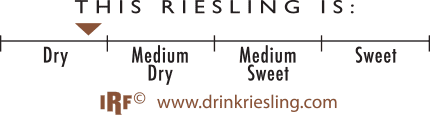
The International Riesling Foundation (IRF) was established in 2007 to simplify Riesling labelling globally. It defines four sweetness categories:
Dry
Medium Dry
Medium Sweet
Sweet
These are determined by the relationship between residual sugar and acidity, and many producers include the IRF scale on back labels to guide consumers, though its use is voluntary.
When in doubt, don’t hesitate to ask your wine retailer or sommelier. Riesling rewards curiosity.